Six thousand four hundred megawatt-hours. That is the battery capacity attached to an auction Rajasthan has just closed, enough to push solar power into the evening peak, when the sun has gone and demand has not.
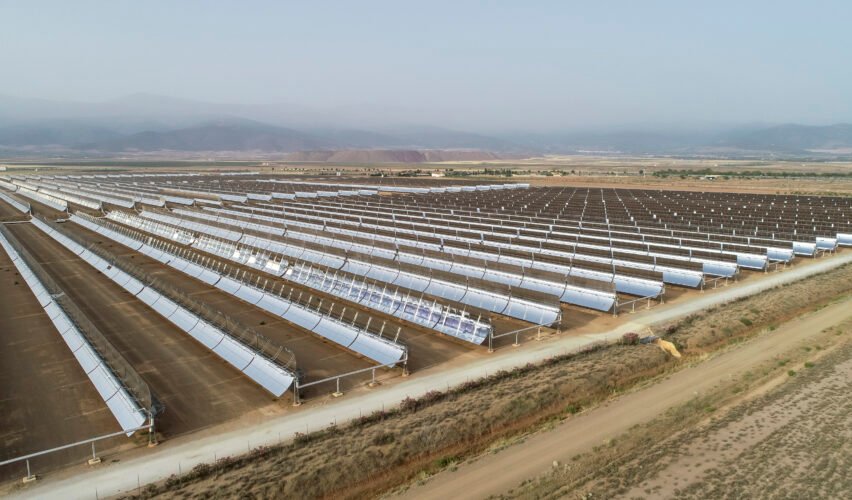
Rajasthan Solar Park Development Company (RSDCL), a subsidiary of the state’s renewable energy corporation, has awarded 2,450 MW of solar capacity with 1,600 MW/6,400 MWh of battery storage at the Pugal Solar Park in Bikaner district. Tariffs in the electronic reverse auction ranged from ₹3.42 to ₹3.54 per kWh across the two lots. The tender was issued in January, and the results came out this week.
Rohit Gupta, chairman and managing director of the Rajasthan Renewable Energy Corporation, announced the Rs 3.42 figure on Wednesday at a Central Electricity Authority event in New Delhi. He called the park India’s largest integrated solar and battery initiative and the rate “a historic low.” That is his description; the sources I found do not give a comparison with other solar-plus-storage tenders.
The tender had two lots. Lot 1 covers 2,000 MW of solar with 1,320 MW/5,280 MWh of batteries, and Lot 2 covers 450 MW with 280 MW/1,120 MWh. In Lot 2, Coal India won 225 MW at ₹3.42, and Leo Energies 6, associated with the investor Actis, took the other 225 MW at ₹3.43. In Lot 1, NLC India Renewables won 1,000 MW and Rama Reflection India 250 MW, both at ₹3.53.
Reports differ on the details. Saur Energy, which reported the 3.53–3.54 range, says Coal India won a 1,000 MW project at the slightly higher ₹3.54. SolarQuarter’s account puts Coal India’s win in Lot 2 at ₹3.42. The Lot 1 award does not add up to 2,000 MW in either report, so the full list of winners needs official confirmation.
The contract terms are strict. RUVITL, the state’s power procurement company, will sign 25-year power purchase agreements on behalf of three distribution companies: Jaipur, Ajmer and Jodhpur. Annual capacity utilisation factor, a measure of how much of its theoretical maximum a plant generates, can be no more than 28%. Output above that limit may be bought at half the winning tariff. Full supply is due 24 months after the agreement takes effect.
The batteries are meant to charge mainly from the park’s solar plants and supply evening peak demand. The Rajasthan Electricity Regulatory Commission approved the procurement earlier this year.
None of the reports I found says the power purchase agreements have been signed. The state’s draft rules for ancillary services, the grid-balancing functions that batteries can also provide, are still described only as coming “very soon.”