
The Chambal has long been the river where India’s rare turtles are counted and protected. The Yamuna, which it joins in Uttar Pradesh, has had far less attention. A new survey suggests that gap in attention has hidden a lot of nesting.
A survey along a 350-km stretch of the Yamuna found 80 active nests of the endangered Indian narrow-headed softshell turtle across 12 river islands and sandbanks, the National Mission for Clean Ganga (NMCG) said. The mission is the government programme that coordinates river rehabilitation in the Ganga basin. It announced the findings on 28 November.
The post-monsoon survey was run jointly by the Wildlife Survival Alliance Foundation India and the forest divisions of Agra, Firozabad and Etawah, with support from the NMCG and the Uttar Pradesh Forest Department. Beyond the nests, the team recorded 19 Gangetic dolphins, 13 gharials and several freshwater turtle and bird species. The gharial is a fish-eating crocodilian with a long, thin snout.
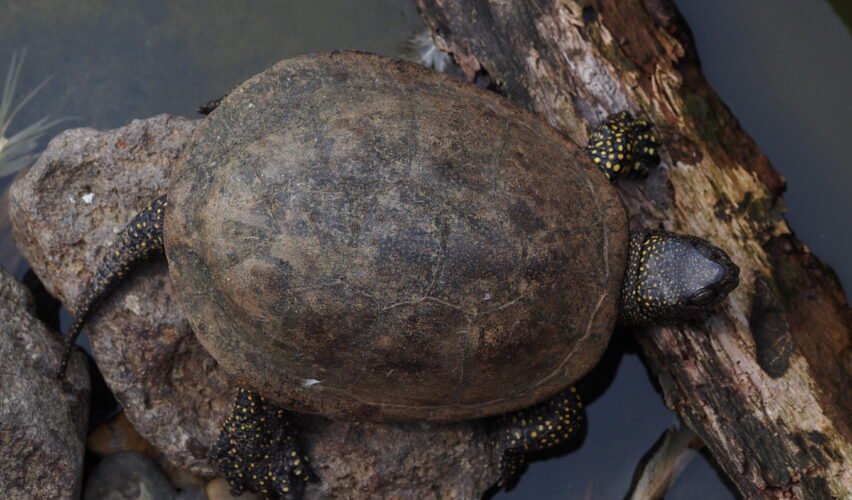
The species, Chitra indica, is large. It is the largest softshell turtle in the Ganga basin, grows over a metre long, and a single mother can bury 90 to 100 eggs in one nest. It is listed as Endangered on the IUCN Red List. The species has declined because of poaching and habitat change. Research on the species describes a reliance on natural sandbanks and undisturbed river margins that makes it highly sensitive to human disturbance.
Earlier work on the Yamuna was patchier. A Turtle Survival Alliance newsletter from 2013 described ten nests on the largely unprotected Yamuna-Chambal confluence during a survey that also covered the upper Ganges and mid-Chambal. That count came from a different area and method, so it cannot be set directly against the new figure of 80. The NMCG statement did not say whether earlier surveys covered the same sandbanks.
Protection work has been moving onto the Yamuna in other ways. A study in the journal Oryx reports that transmitters were attached to ten captive-reared turtles, five male and five female, which were released into the Yamuna in Agra district on 28 November 2024. Those animals came from a nest protection and head-starting programme begun in 2012 by the India Turtle Conservation Program with the Uttar Pradesh Forest Department.
The NMCG said conservation efforts have also begun in the Agra stretch, where community meetings and engagement with frontline forest staff have brought local people together to keep watch over the nests. The statement gave no details on hatching success or on how the nests will be guarded through incubation. It also did not say when the survey was carried out.
The mission framed the finding as a case for the Yamuna’s standing alongside the Chambal, and as part of a wider aim for the Ganga system. In its words: “A living Yamuna is a living Ganga.”