Fifteen people from Chile Chico, a town in Chile’s Aysén region, travelled 211 miles this year to stand beside a holding pen and watch young birds walk out of it. Residents of Chile Chico, Puerto Ingeniero Ibáñez, Villa Cerro Castillo and Cochrane took part in the release events. Nobody was paid to make the trip. They went because a bird their grandparents might have seen on the open steppe had become a rarity, and they wanted to see it put back.
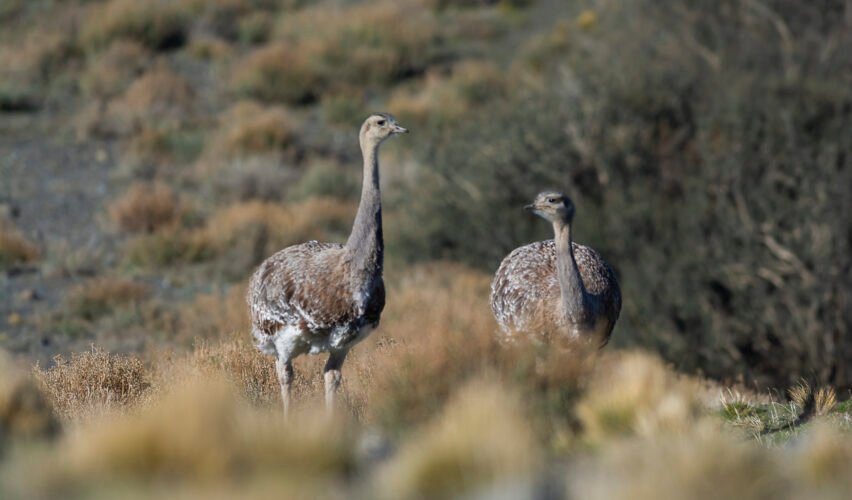
The bird is Darwin’s rhea, known locally as the ñandú. It is a flightless, ostrich-like runner that stands about a metre tall. Mongabay recently followed a women-led team in Patagonia National Park as it prepared 13 of these birds for release in April 2026, working with the Rewilding Chile Foundation.
Why the steppe went quiet
In the Aysén region, more than a century of overgrazing, hunting and nest destruction threatened the rhea’s survival. Sheep ranching reshaped the Chacabuco Valley. According to Cristián Saucedo, Rewilding Chile’s wildlife director, by the time sheep ranching ended there, the nandu had almost completely disappeared.
The numbers were small. Just 18 birds were left in the Chacabuco Valley by 2015, and that little band was cut off by almost 200 kilometres from the nearest other Darwin’s rhea population, at the Baño Nuevo ranch near Coyhaique. A group that small, with nowhere to go for new genes, can wink out without anyone noticing.
Rheas matter to more than bird-watchers. They help keep grasslands healthy by dispersing seeds that renew plant growth. Conservationists also hope the birds will again associate with guanacos, the wild relatives of llamas, to watch for puma attacks.
A breeding centre and some adoptive fathers
The recovery programme started in 2014. The reproduction centre began operating in 2015 inside Patagonia National Park. The park itself is a patchwork of former ranch land. Tompkins Conservation donated more than 200,000 acres in 2019 to help create the 750,000-acre park.
The centre leans on a quirk of rhea biology. The male, not the female, raises the chicks, and he will look after the eggs of several females. Technicians use that. Male rheas act as adoptive parents for chicks from eggs laid in the park and from donated eggs incubated near Coyhaique.
Release is a process, not a gate swinging open. A writer who visited last year described it: mandatory health checks, parasite treatments, and a spell in open-air pens where the birds gain strength and learn to fend for themselves. The aim is not to domesticate them, but to give them just enough of a head start to survive predators and Patagonia’s harsh winters.
The people in the pens
That visitor’s account centred on Emiliana Retamal, a young veterinarian turned wildlife ranger on a small Rewilding Chile team trying to bring rheas back to the Chacabuco steppe. On release day she asked visitors to slow their movements, talk less and follow her lead. The work is quiet. Birds that are not tame have to be coaxed into wooden crates with a patient and steady hand.
Afterwards the team spends weeks in the field. Collars give glimpses of survival, but much of the knowledge still comes from old-fashioned tracking of footprints across the steppe. Rewilding Chile says its team monitors the behaviour and integration of released birds and tracks their movements. The newcomers typically try to join other rhea groups grazing in the Entrada Baker sector.
Birds from across the Andes
The 2026 releases followed a bolder move the year before. In March 2025, Rewilding Argentina and Rewilding Chile brought 15 Darwin’s rheas across the Andes from Patagonia Park in Argentina to Patagonia National Park, billed as the first international translocation of wild animals for release in the Southern Cone. The point was genetic. The visitor’s account noted that the wild birds moved as a tighter group and were uneasy around people, which is what the team wanted.
One of those animals is now a minor celebrity. A female nicknamed “The Argentine,” released last year and fitted with a GPS collar, has covered more than 247,105 acres, linking Valle Chacabuco with Paso Zeballos in Argentina and the Jeinimeni sector. That revealed a seasonal altitude movement nobody had documented. The programme hopes to study it further.
What 2026 looked like
Rewilding Chile reported on 8 May that three releases in the steppe had put 39 chicks into Patagonia National Park during March and April. The birds had flown in last February from the breeding centre at Quimán Reserve in Futrono, Los Ríos Region, and waited in acclimatisation pens. The programme works with CONAF, the national forestry corporation, SAG, the agriculture and livestock service, and Quimán Reserve, with support from the Carabineros police and the Chilean Army. Representatives from Peru’s wildlife service, Serfor, also attended, as that agency works to strengthen the population of the northern rhea subspecies.
Saucedo has long argued that hands-on restoration is what keeps the species going. “Active restoration of rheas has proved instrumental to its survival,” he said in 2021. In May he said the effort would continue while the bird remains endangered, with ongoing action to control threats such as harassment and attacks by dogs.
Counting what is left
The count has grown since the start. From a ghost population of 22 birds, more than 70 now roam the Chacabuco steppe. A 2025 report put the figure at about 68 in the park, with a goal of 100 adults in the wild to create a self-sustaining population. The programme’s stated target is at least 100 adults, with at least four actively reproducing. The chicks released this March and April are not yet adults, so they don’t count towards that goal.
The next piece of work is on the ground. On 31 July, Rewilding Chile opened applications for a Patagonia National Park volunteer programme to help restore Darwin’s rhea habitat. Details of the dates and requirements are on the foundation’s pressroom page.