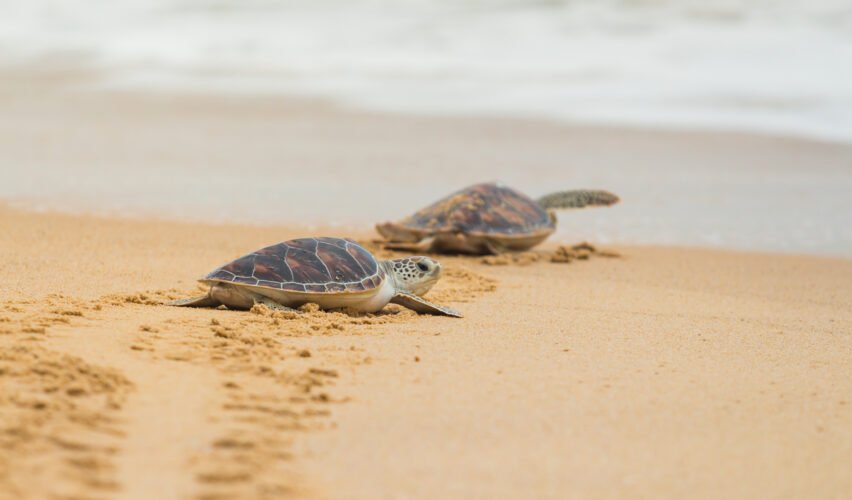
At dawn on Mataking Island, off Sabah’s east coast in Malaysian Borneo, a green turtle hatchling the size of a palm crawls across the sand toward the sea. It weighs about as much as a single battery. If it survives, it could grow to 1.2 metres and 200kg.
Scientists in Malaysia now use tiny tissue samples to work out where turtles like this one come from. Marine biologist Juanita Joseph, at Universiti Malaysia Sabah, is helping build ShellBank, a global DNA database of marine turtle populations. The reasoning is simple. Mature females return to the beaches where they hatched every two to four years, but between nesting seasons they cross vast stretches of ocean to feeding grounds far beyond Malaysia.
The method is based on the “haplotype”, a kind of genetic fingerprint revealed by sequencing. Match a sample from a carcass or a shell to the database and you can say which nesting population it came from, and so where the animal was taken.
It has been used on real cases. After 53 green turtle carcasses were found on Pulau Tiga, near Kudat in Sabah, in 2014, researchers analysing their DNA concluded that the turtles came mainly from the Sulu and Celebes Seas. More recently, the work has shown that turtles foraging in parts of Malaysia come from Micronesia, and identified the likely source of turtle shell intercepted in Britain.
The stakes are high because the species is recovering. In 2025, green turtles moved from “endangered” to “least concern” on the IUCN Red List, the first marine turtle species to leave the threat categories. In Sabah’s Turtle Islands Park, more than 20,000 nests are recorded annually, and Sabah Parks says more than 14 million hatchlings have been released since 1977. That contrasts with the WWF’s Living Planet Report 2026, published this week, which found a 73 per cent decline in monitored vertebrate wildlife populations between 1970 and 2022.
Poaching has not stopped. Turtles are still targeted for meat and eggs, which are sought as exotic delicacies in parts of Vietnam and China. Gavin Jolis, marine species strategy manager at WWF-Malaysia, says protection has to follow the whole life cycle. “That’s where the genetic work comes in,” he said.
The DNA work is expanding. ShellBank’s builders said it would initially focus on the Asia-Pacific region, where more than 1,000 turtle products and significant quantities of raw shell were confiscated in Indonesia, Malaysia and Vietnam between 2015 and 2018. In May, Sabah signed an agreement on a project called BC4T that combines genetic and movement data to define distinct turtle populations across the region.
The database traces where animals come from. It cannot stop anyone from taking them. Sabah Parks director Maklarin Lakim told This Week in Asia that the problem is geography: “These are marine parks and there are no boundaries that we can physically fence off.”