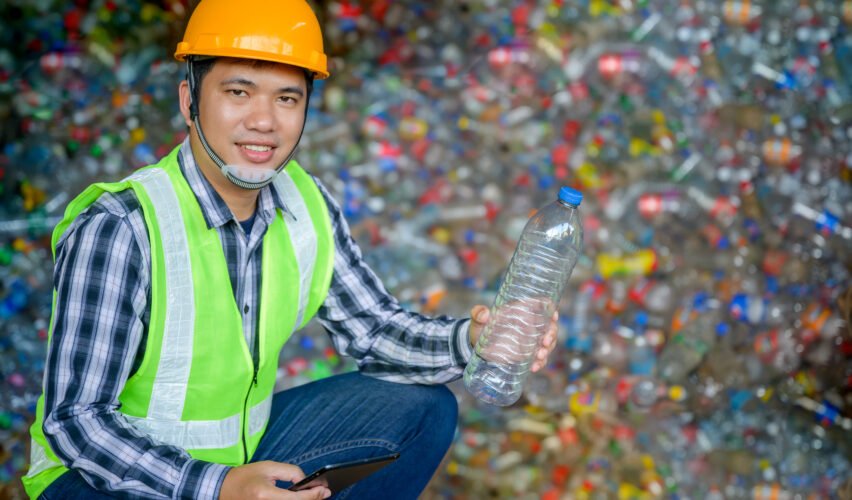
Large companies in the Philippines are the clearest test of how national plastic rules are changing Asian business. The Extended Producer Responsibility Act, in force since July 2022, applies to firms with assets above 1 billion pesos. It makes them recover a rising share of their plastic packaging waste. With the UN treaty stalled, governments from Jakarta to Taipei are writing their own rules, and they differ widely.
What does the Philippine law require?
“Recovery” can mean buy-backs, collection points, clean-ups, or building recycling or composting facilities. Firms had to recover 20% of the previous year’s plastic footprint by the end of 2023. The target rises ten points a year to 80% by the end of 2028. One regional analysis puts the penalties at 5 to 25 million pesos a year.
Is every country using the same model?
No. A sustainability data group describes fee-based systems, where producers pay per tonne into government funds (Vietnam, and a draft in Thailand), and compliance-based systems, where producers must show physical collection and recycling (the Philippines and Indonesia). The OECD’s regional outlook counts four ASEAN countries (Indonesia, the Philippines, Singapore and Vietnam) in the early stages of plastic packaging schemes, with Thailand still discussing one.
Outside Southeast Asia, Japan enforces mandatory plastic bag charges and Korea has phased bans on specific single-use items. Taiwan has charged a “Green Fee” on plastic containers since January 2025. Its environment ministry announced results of the policy on 26 May 2026. China’s new Ecological Environment Code, promulgated on 12 March 2026, includes a circular economy section promoting eco-design and recycled materials.
Are the rules being enforced?
Unevenly. The OECD found that progress on waste management, recycling and single-use bans has been significant, but gaps remain in coverage and enforcement. It adds that in some cases banned items are replaced with other single-use items, which may not yield better environmental outcomes.
Indonesia shows the problem. Jakarta banned plastic bags in 2020, yet researchers who surveyed the city’s rivers said monitoring and implementation were hard. One analysis cites the Indonesian Packaging Recovery Organization as saying compliance with the national producer rules was below 5% as of mid-2025. In February 2026 the NGO Dietplastik Indonesia released a report on monitoring and enforcement of single-use plastic rules.
How are import bans changing supply?
The shift began when China closed its doors. China’s ban on plastic waste imports began in July 2017. Afterwards, imports to the Philippines, Malaysia and Indonesia more than doubled. Those countries have since pushed back. Thailand and Indonesia halted plastic scrap imports in January 2025. Malaysia has tightened its import rules and, since April 2026, banned e-waste imports outright.
That squeezes the recycled plastic that regional manufacturers need. The EU is tightening from the other side. New vehicle models sold there must contain at least 15% recycled plastic from 2032, rising to 25% from 2036, and packaging rules set recycled-content minimums from 2030.
Where does the global treaty stand?
Nowhere near a deal. Talks in Geneva in August 2025 ended without agreement after 10 days. Countries could not agree whether to cap new plastic production or focus on waste management, reuse and design. The negotiating committee was due to reconvene on 7 February 2026 to elect a new chairperson. Consultancy Bower Group Asia notes that countries are moving ahead with rules on producer responsibility, plastics and packaging even as global talks stall.
What happens next?
On 21 November, the European Union will ban plastic waste exports to non-OECD countries. Days before, on 16 and 17 November, the Plasticity Forum will bring brands, manufacturers and policymakers to Kuala Lumpur.