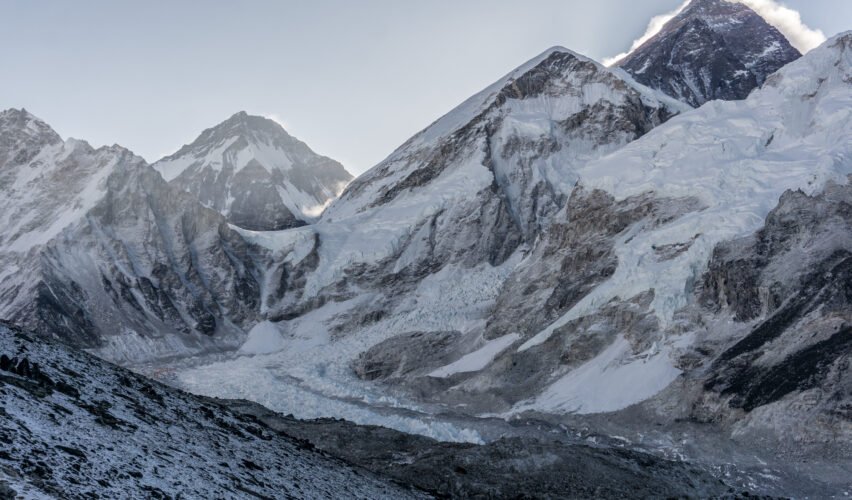
Camp 2 on Everest sits at about 6,400 metres (21,000 feet). Guides there have begun finding standing water in a place that had stayed frozen and where water had never been seen, according to Jamling Tenzing, 61, son of Tenzing Norgay Sherpa, who made the first ascent with Edmund Hillary in 1953. He spoke as a biopic of his father brings the old expedition back into view.
Jamling Tenzing says Nepal’s recent disasters are warnings, not one-offs. He recalled that Thame, his father’s birthplace at 3,800 metres, was devastated two years ago when a glacial lake burst its banks. “This is now the biggest threat,” he said, as meltwater builds pressure in glacial lakes until their natural barriers give way.
A summer of collapses
This year’s events give the warning some weight. On 30 July, an avalanche struck Pakistan’s Broad Peak in the Karakoram range and killed 10 climbers, among them the British-Nepali mountaineer Nirmal “Nimsdai” Purja. Avalanches have always been part of high-altitude climbing, and no single one can be pinned on warming. But the event renewed focus on how climate change is increasing avalanche risk, glacier melt and unstable weather.
The deadlier event came a month later. On 26 August, part of a glacier and the mountainside beneath it collapsed on the north side of Langtang Lirung, a 23,734-foot peak near Nepal’s border with Tibet. The collapse set off a 60-mile flood of water, mud and debris. At least 165 people died and entire villages were swept away.
The cause was first reported as an earthquake. The US Geological Survey later said the seismic signal came from a glacial collapse and debris flow, not a quake. Benjamin Horton, dean of the School of Energy and Environment at City University of Hong Kong, called it a possible “compound event”. Here, a seismic jolt interacts with glacier loss, thawing permafrost and slope instability to produce a more damaging disaster than any one factor alone. Permafrost is ground that stays frozen year-round and acts as glue on steep rock.
What climbers are seeing on Everest
The snow is thinner than it was. Tenzing David Sherpa, an Everest climber, said that on earlier expeditions crampons were needed at lower elevations, whereas now climbers must go much higher before they meet suitable icy terrain. He also described streams and small flowing channels forming in the Khumbu Icefall from rapid melt.
The icefall is the broken, moving glacier that every south-side climber must cross. This spring, climbers were stalled for weeks after a massive unstable serac, a hanging block of glacier ice, cracked above the route. Around 900 climbers and guides were waiting at base camp. Ang Tshering Sherpa of Asian Trekking said the ice is safer in the morning, “but in the afternoon it becomes dangerous as weather gets warmer.”
Climbers are not the cause of the melt, but their camp adds some of it. A July 2026 study in Regional Environmental Change used field data from the spring 2023 season. It put the heat from fuel burning and human urine at about 849,174 megajoules, enough to melt roughly 2,492 tons of glacier ice and snow. One reviewer of the paper noted that climbers are not the principal culprit.
The wider region is drying out
Ice and rock are one part of the change. Snow is another. The International Centre for Integrated Mountain Development (ICIMOD), an intergovernmental body based in Kathmandu, tracks snow persistence, meaning how long snow stays on the ground. For November 2025 to March 2026 it was 27 per cent below the long-term average. That was the fourth straight yearly decline. Only two of 12 major river basins, the Ganga and the Irrawaddy, recorded above-average snow. The shortfall threatens river flows and livelihoods for nearly two billion people.
Underlying that is the temperature trend. ICIMOD says the Hindu Kush-Himalayan region has warmed by about 0.3°C per decade in recent decades. Even if global warming is held to 1.5°C, the region could lose up to a third of its glacier volume by 2100.
The Alps got there first, or at least louder
Other ranges show where this goes. In Switzerland, the 2025 collapse of the Birch Glacier buried Blatten and three hamlets and destroyed 130 houses and the church. Only one person died, because a monitoring programme gave residents early warning.
This summer the effect reached climbing itself. Mountain huts closed, and guides stopped taking clients up the “normal” routes on the Matterhorn and Mont Blanc because heat-driven rockfall made them too dangerous. Swiss glacier monitors reported a 5.5% loss of ice in 2026, according to a report by Nature World News.
Monitoring worked at Blatten because the Alps are densely instrumented and the valley could be emptied in a day. The Himalayas have fewer sensors, and the villages below the glacial lakes are often hours from the nearest road. Mountaineering there still depends largely on the judgment of Sherpa guides reading the ice by eye, day by day.
Scientists agree that glacier loss in the Hindu Kush Himalaya will continue through this century. What nobody has yet worked out is how many of the region’s glacial lakes, unstable slopes and climbing routes are close to failing, or how much warning anyone below them will get.