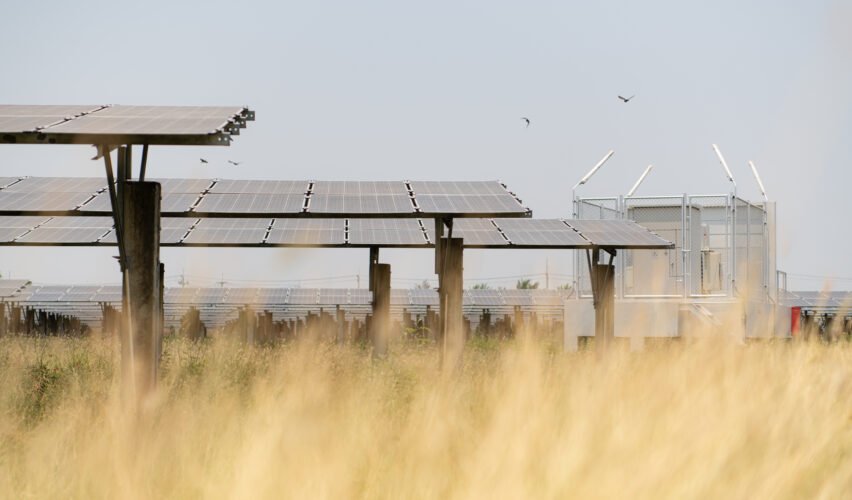
India had 0.11 GW of grid battery storage at the end of 2024. The Central Electricity Authority (CEA), the government’s power planning body, says integrating 364 GW of solar and 121 GW of wind by 2031-32 would need 73.93 GW of storage, of which 47.24 GW would be batteries. That is more than 400 times the battery base of two years ago. Later estimates put today’s figure higher, but the distance is still very large. A new opinion piece in pv magazine India argues that hitting the number is only half the job.
What is “storage intelligence”?
It means the software that decides when a battery charges, discharges or holds back. The piece is by Kumar M., founder of Smart Grid Analytics. He argues that an energy management system (EMS) has to become the decision-making system connecting generation, storage and grid requirements, not just a tool for monitoring assets. His summary is that storage becomes an intelligence problem.
Why isn’t a bigger battery enough?
Because the obvious rule, charging whenever there is spare solar, can be wrong. The author lists the complications. A demand surge may be coming later. The battery may need to hold a minimum charge for grid support services. Schedules and market conditions can change within the same period. Aggressive cycling can earn money today and shorten the battery’s life. Each is a decision made continuously, not a specification written once.
What is being wasted right now?
Much of today’s waste is a transmission problem, which software cannot fix alone. ICRA, a ratings agency, said around 33% of the 54.8 GW of recently commissioned renewable capacity was being evacuated through the temporary general network access route as of May 2026. Curtailment on that route runs at 50% to 60% during solar hours. Curtailment means grid operators ordering plants to switch off. It is worst in Rajasthan and Gujarat.
In Rajasthan, developers told the CEA that nearly 4 GW of commissioned capacity was still being curtailed at peak solar hours even after a new 765 kV line opened. Batteries that soak up midday surplus and release it in the evening are the obvious partner. How well they do that depends on forecasts and dispatch decisions, which is the author’s point.
What is the government doing about it?
Money and rules. A second round of viability gap funding, worth INR 5,400 crore to support 30 GWh of standalone battery projects, comes with a 20% domestic value-addition requirement. Viability gap funding is a capital grant that closes the gap between what a project costs and what buyers will pay.
The CEA has also published a draft rule. Ground-mounted solar and onshore wind projects commissioned after 1 July 2027 would need co-located storage of at least 10% of plant capacity, lasting two hours. A 100 MW solar plant would need 10 MW of storage, or 20 MWh. For projects commissioned from July 2029 to June 2031, the minimum duration rises to four hours. The same draft would require at least 15% of inverters to have grid-forming control. Those are inverters that actively help hold grid voltage and frequency steady.
Will demand keep up the pressure?
Yes. The piece cites the International Energy Agency’s view that electricity demand will grow 6.4% a year to 2030, adding more than 570 TWh. The IEA also expects variable renewables to supply 24% of generation in 2030, against 14% in 2025. A grid with that much weather-dependent supply has more decisions to make each hour.
What are the limits of the argument?
The piece is opinion from someone who sells grid analytics, and it offers no measured gains from smarter control. Transmission delays also matter. ICRA found that only 12% of transmission projects commissioned by March 2026 under the competitive bidding route were on schedule. Smart dispatch cannot move power down a line that does not exist.
The CEA’s draft is not yet final. Public comments closed on 4 October 2026, and the earliest the storage requirement would apply is 1 July 2027.