
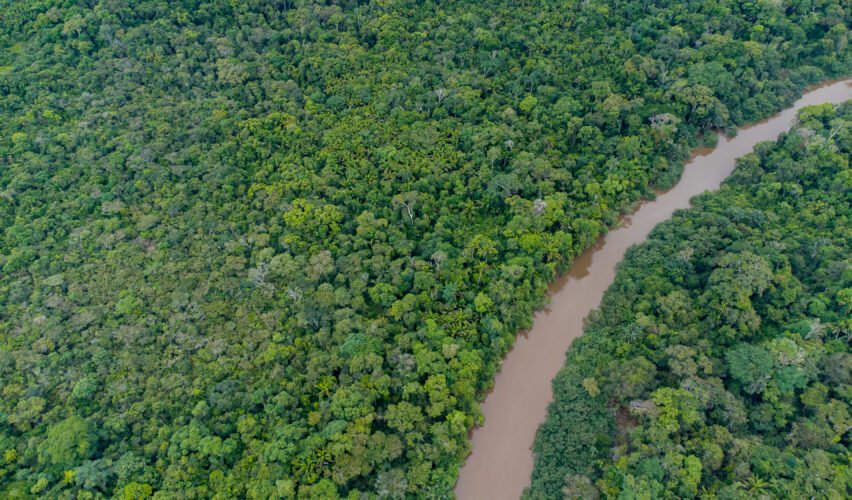
Tropical Africa lost 2.4 million hectares of forest in 2025, close behind tropical Latin America and the Caribbean at 2.5 million. A few years ago the gap between the two regions was far wider. The narrowing comes from one region improving and one worsening.
The figures come from the Forest Declaration Assessment 2026, released on 13 October, which reports that global deforestation fell 15% between 2024 and 2025. That is the sharpest annual decline since the 2018–2020 baseline. Even so, just over 7 million hectares were cleared, linked to an estimated 3.9 billion metric tons of carbon dioxide equivalent in emissions. The report was produced by more than two dozen research and civil society groups, with Climate Focus as coordinator. It found the world is 70 per cent off track to meet its 2030 goal of ending deforestation.
Brazil did much of the work. Tropical Latin America and the Caribbean cut deforestation to 33 per cent below the baseline average. The authors found that Brazil’s Amazon did the most to reduce commodity-driven deforestation, with enforcement actions more than doubling relative to the previous four-year average.
Other data point the same way. Global Forest Watch, run by the World Resources Institute, reported that forest loss not caused by fires hit a record low in Brazil in 2025. Brazil’s space research institute, INPE, counted the area destroyed between August 2024 and July 2025 as 11% less than the previous year, the lowest since 2014. In the first half of 2026, an estimated 1,295 square kilometres were cleared in the Brazilian Amazon, a 38 percent drop on the same period last year.
The authors warn against reading too much into one year. Erin Matson, the assessment’s principal author, said: “This makes last year an exception rather than a new normal.” She added that the fall looks good partly because earlier years were so bad. Elizabeth Goldman of Global Forest Watch made a similar point in April. She said part of the decline reflected a lull after an extreme fire year.
Africa is moving the other way. The authors attribute the rise there to smallholder farming, growing timber, and mineral extraction, in a region where enforcement has not kept pace.
Brazil’s own gains are not secure either. A September analysis noted that the Cerrado savanna still accounts for a large share of the country’s vegetation loss, and that sustaining reductions requires durable enforcement capacity amid political pressure to weaken protections.
The next test is the official annual count. INPE’s Deter alerts for the Amazon fell to 2,874 km2, a 36% drop on last year, and the final PRODES figure is due in the coming months. If it confirms the alerts, Brazil will likely post its lowest official deforestation rate since satellite monitoring began in 1988.