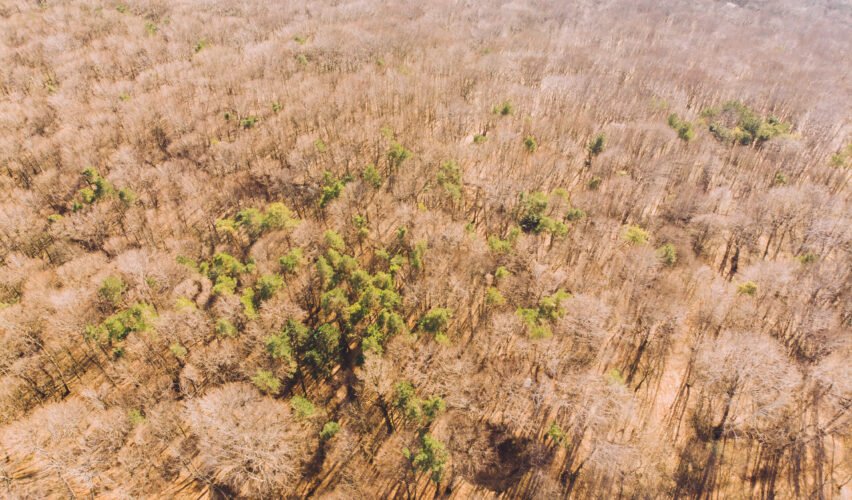
During the 2023-24 El Niño, 75% of the world’s tropical forests experienced drought and heat that were more extreme than usual. The finding comes from a study in the journal Earth’s Future, led by Johanna Van Passel of Ghent University. It also looks ahead, and the picture there is uncomfortable. Here are the numbers that matter.
75%: the share of forest hit
Over three quarters of tropical forests endured an average of six months of anomalous drought and heat. The team defined “anomalous” against each region’s own normal, so a month counts as extreme for the place where it happened.
15.9 million sq km: the area studied
The data covered the Americas (8.4 million sq km), Africa (3.6 million) and Asia (3.9 million). The team analysed 12 datasets of heat and drought observations from the past 25 years.
18 months: how long the heat lingered
The forests stayed unusually hot for roughly 18 months, on average. About 80% were also drier than usual, and parts of the Amazon had a full two years of anomalous drought. That is a long time for a tree to go without relief.
19%: the rise in forest degradation alerts
Researchers cited by Brazil’s FAPESP research foundation reported a 9% average increase in burned areas and a 19% increase in forest degradation alerts during the event. Their reading is that the cycle of drought, fire and degradation is intensifying and cutting the forest’s ability to recover.
Nine times: the Amazon’s drought risk by 2100
Under high emissions, Amazon droughts of comparable severity could become nine times more likely by 2100. The projections use 24 climate models run for four emissions scenarios.
Six times: the floor, even with cleaner pathways
Even in a world that reaches carbon neutrality by 2075, the high annual temperatures of 2023 and 2024 become at least six times more likely in all tropical regions by 2100. Under probable emission paths, that heat could become the “new normal” in less than 20 years.
Taken together, the numbers describe an event that was no passing scare. The 2023-24 El Niño was not the strongest on record, but it struck a warmer baseline climate, in the first year global temperatures passed 1.5°C above pre-industrial levels. The forests involved have traditionally absorbed about 1.2 petagrams of carbon a year. The authors say avoiding this future takes rapid and drastic cuts in greenhouse gas emissions. Which of the four emissions scenarios the world actually follows is still undecided.