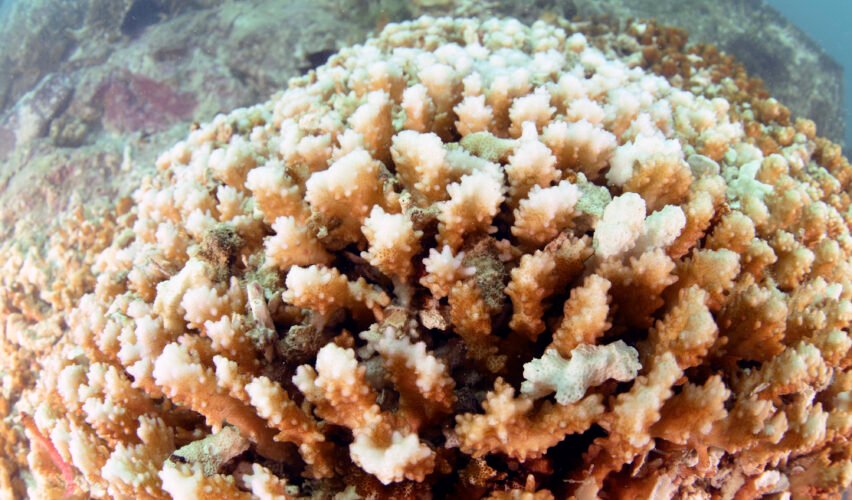
Coral reefs used to have decades to recover after a mass bleaching event. Now they are lucky to get five or six years, and for many of the reefs battered by the marine heatwaves of 2024, this year’s El Niño leaves little more than twelve months.
That is the assessment of Manuel González Rivero, a reef scientist at the Australian Institute of Marine Science and lead author of a major report from the Global Coral Reef Monitoring Network (GCRMN). He says the shortened gap is creating a “staircase of decline” that gets harder to reverse with each bleaching event. The report came out at the end of August, and the UN Environment Programme has since used it to warn that reefs are being hit again before they have recovered. UNEP likened them to an overmatched boxer taking repeated blows.
The Pacific is supplying the next blow. On 8 October, NOAA’s Climate Prediction Center kept its El Niño Advisory in place. It said the event continues to strengthen, with a strong-to-very-strong El Niño likely through January–March 2027. The chance of a historic event, exceeding anything in the record since 1950, is put at 83% for October–December. Sea surface temperature anomalies exceeded +4.0°C in parts of the eastern equatorial Pacific last month. UN Secretary-General António Guterres has said a warming climate is “supersizing” El Niño.
The reefs are arriving at this heat in poor shape. From early 2023 to mid-2025, 84% of the world’s coral reefs experienced bleaching-level heat stress, with mass bleaching documented in at least 83 countries and territories. That compares with 21% in the first global event in 1998, 37% in 2010 and 68% in 2014–17. NOAA says the fourth event likely ended in mid-2025. Derek Manzello, who coordinates NOAA’s Coral Reef Watch, has said reefs are now in an era of near-annual bleaching, which makes it harder to say when global events begin and end.
The GCRMN report is built on 21.1 million observations from 36,886 reef sites in 124 countries and territories. It found a 9.5% relative decline in global hard coral cover compared with 1980–2009 levels. Every major global bleaching event since 1998 has reduced hard coral cover, and reefs only partly recover before the next heatwave. Its authors note that reefs can regain coral cover when disturbances are reduced and recovery time is sufficient, as after the 2016–17 event. The data predate the latest event, so the picture may be worse than the report shows.
The pattern is not new. A 2017 study in Science of 100 reefs found the average gap between bleaching events had fallen to less than half of what it was before. The Mongabay India report that prompted this story notes that every strong El Niño since 1998 has coincided with a global bleaching event.
Warnings for this season are already out. NOAA Coral Reef Watch’s four-month outlook, published on 21 July, indicated a high risk of coral bleaching across the globe from August through November. The scientists behind the report say local action still counts. Poor water quality, overfishing and coastal development leave reefs less able to withstand heatwaves. The IPCC’s assessment remains stark: 70–90% of warm-water coral reefs are expected to disappear even if warming is held to 1.5°C.
The next checkpoint is 12 November, when NOAA’s Climate Prediction Center is scheduled to publish its next monthly ENSO Diagnostic Discussion. It will show whether the October–December reading is heading for the record.