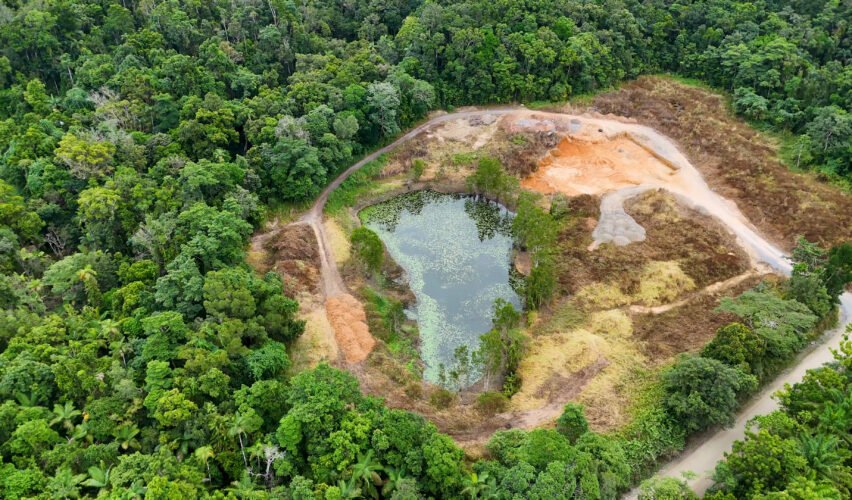
In photos taken on 5 May 2026 by the monitoring group Auriga Nusantara, an excavator works inside the Merauke Food Estate in South Papua. It is clearing a natural ecosystem dominated by small-diameter Melaleuca trees. The images are geotagged to specific coordinates inside the estate.
Five months later, the government says it will stop doing that. Hashim Djojohadikusumo, President Prabowo Subianto’s younger brother and special envoy for climate and energy, told a sustainability forum in Jakarta on 6 October that Indonesia had reached its rice self-sufficiency target three years early. He said it did so without planting the two million hectares of food estates it had planned. Speaking for the Agriculture Ministry, he said: “The government sees no further need to expand rice cultivation in so-called forest areas.”
Hashim and fellow envoy Mari Pangestu said the government would no longer expand food estates into forest and would end deforestation for food and biofuel growth, shifting future expansion to degraded land. The announcement covers the Merauke project, which campaign group Mighty Earth calls the world’s largest single deforestation project. The project aims to clear 3 million hectares in Merauke regency. Mighty Earth welcomed the decision as a win for nature, climate and local communities.
The details are thin. Hashim said the government cannot yet say that all activities in South Papua and Central Kalimantan will automatically stop, or when. He said the Agriculture Ministry and other agencies would have to spell that out. He also said that labelling land “degraded” does not by itself mean it can be converted, and that any change in land use must follow existing law.
Clearing has already happened. Monitoring by the local network Merauke Solidarity found that land clearing and deforestation linked to the South Papua national strategic project have affected 49,787 hectares since 2024. Mongabay reported that heavy machinery is still clearing natural forest in several parts of Papua targeted for rice, sugarcane and oil palm. A Greenpeace report found 10 companies hold sugarcane concessions covering about 560,000 hectares in Merauke, and its analysis of government maps puts the broader project at about 2.7 million hectares.
Critics doubt the wording. Merauke Solidarity questions “degraded land” when it is defined only by biophysical or economic measures, ignoring ecological function and Indigenous knowledge. The group also notes that Indonesian officials have made similar pledges at international forums before, and these have often failed to change programmes on the ground. Researcher David Gaveau, quoted by Mongabay, asked whether land now classed as non-forest use could still be converted even if it remains forest on the ground.
The next step is with the ministries. Hashim has left it to the Agriculture Ministry and other agencies to say which work in South Papua and Central Kalimantan stops, and when. No date has been given.